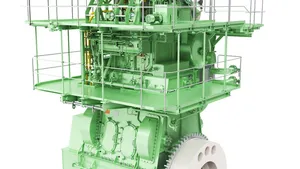
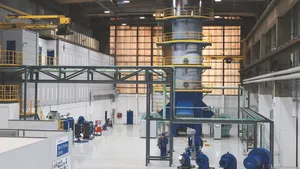
The Exhaust Gas Recirculation (EGR) solution being developed by MAN Diesel & Turbo with Alfa Laval support is proving its potential aboard two A.P. Moller-Maersk vessels, say Alfa Laval.
Between the Alexander Maersk and the Maersk Cardiff, nearly 3500 hours of EGR operation have been logged to date. These seagoing installations, which involve water cleaning with Alfa Laval’s PureNOx, show why EGR is at the forefront of Tier III NOx abatement – and how fuel can be saved in Tier II operation.
Alfa Laval explain that EGR, which involves the recirculation of exhaust gas, is one of two technologies being developed to meet Tier III NOx limits without resorting to liquefied natural gas. Unlike Selective Catalytic Reduction (SCR), which is an after-treatment technology that removes NOx with the help of a catalyst, EGR is integrated into the engine and prevents the formation of NOx during combustion.
The advantages of EGR can be seen clearly in installations aboard two container vessels. The Alexander Maersk, a vessel of 1092 TEU whose MAN B&W 7S50MC engine was retrofitted with an EGR prototype in 2010, has spent more than 2200 hours operating at 50% NOx reduction over today’s basis emission level.
Lessons learned in this installation have gone into the 4500 TEU newbuild Maersk Cardiff, whose EGR-equipped engine is fully compliant with Tier III and also well past the 1000-hour operating mark.
“Alfa Laval is proud to be part of these pioneering EGR installations, where our PureNOx has the vital role of cleaning the wash water in the wet scrubber,” says Alfa Laval’s Kristina Effler, Business Manager, Water Treatment Exhaust Gas Emissions. “No other vessel has EGR installed and operating reliably at Tier III. Moreover, it has been possible to demonstrate substantial fuel savings at Tier II.”
Furthermore, adds Alfa Laval, the ability to save fuel in addition to complying with Tier III NOx limits is of vital interest to ship operators as they plan for 2016. A fuel-optimized Tier II operating mode, which facilitates an approximate 4 g/kWh reduction in fuel consumption at partial load, was introduced by MAN Diesel & Turbo with the two-stroke MAN B&W 6S80ME-C9 engine in 2012.1 This is the engine now installed aboard the Maersk Cardiff, where it is operated entirely by the crew and has logged nearly 350 hours in this mode.