Naval Surface Warfare Center, Carderock Division (NSWCCD) completed Military Sealift Command hospital ship USNS Mercy (T-AH19) Anemometer Positioning Evaluation (APE) testing in support of Naval Air Systems Command (NAVAIR) and Military Sealift Command (MSC), Feb. 8. The testing focused on measuring the airflow of anemometers, wind measurement sensors that are installed on the superstructure of U.S. Navy ships. The APE testing is required to complete the aviation certification process following a new helicopter hangar installation on the ship’s superstructure.
“NAVAIR certifies the safe operating range of wind measurement during flight operations aboard Navy ships underway,” said Joshua Butler, NAVAIR engineer. “The results from the APE testing provide data that will determine a usable range of wind directions for the anemometers to help ensure safety while launching and recovering aircraft. Additional data will give us an empirical database to better understand the placement of anemometers for the topside design of future Navy ships.”
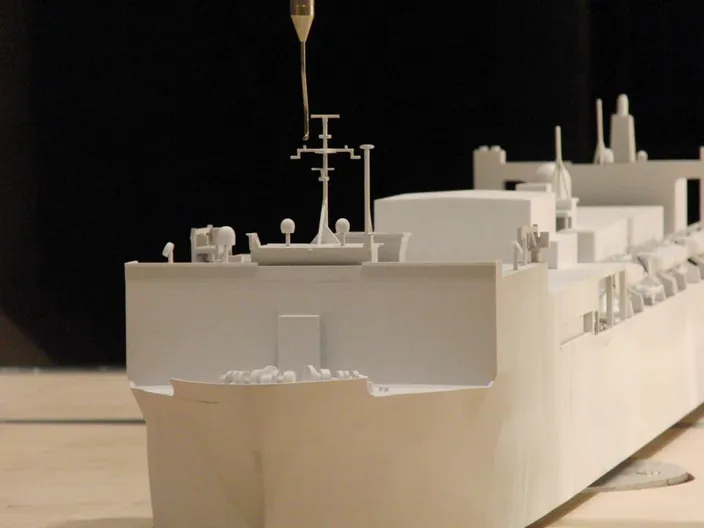
In Jan., NSWCCD printed a 3-D scale model of Mercy’s hull with several removable top-side structures. NSWCCD engineers supported the testing in the 8 by 8 foot Anechoic Flow Facility (AFF), a closed-loop wind tunnel which quantifies aerodynamic and acoustic properties of scaled ship or aircraft models and sub-system components.